Clearer decisions for retention, quality, and planning
We help higher education institutions turn scattered data into indicators, alerts, and tools that make concrete decisions easier.
Concrete problems we tackle in institutional management
We spot the bottlenecks that recur in small and mid-sized institutions, where information does not reach decision-makers in time.
Information scattered across departments
Academic, administrative, and student-services data fragmented across Excel files and isolated systems.
Indicators that arrive too late
Reports prepared at the end of the term, after dropout or non-compliance has already happened.
Uncertainty in student support
Hard to know exactly where to focus tutoring and student well-being programs.
Goals and milestones without continuous tracking
Improvement plans and strategic goals reviewed only in occasional committee meetings.
Evidence prepared by hand
Exhausting manual consolidation of documents and evidence for program licensing or accreditation.
Reports not built for decisions
Plenty of descriptive charts that never point to the specific alert or the decision required.
Two initial fronts of institutional work
Student retention and success
We organize academic and trajectory signals to help prioritize student groups, programs, and support actions.
- Consolidated absenteeism and course-repetition alerts
- Prioritization of critical core courses
- Better targeting of tutoring and well-being resources
Quality and planning
We connect indicators, goals, owners, evidence, and improvement plans to make institutional follow-up easier.
- Continuous tracking of strategic goals
- A central evidence repository by department
- Early alerts before institutional committees
How we work in practice
An iterative process designed to prove value quickly, without upfront costs or rigid commitments.
Pick the priority decision
We identify one critical question the institution needs to answer more clearly today.
Assess the available data
We review existing sources (ERP, LMS, surveys, Excel) and their quality limitations.
Build a working prototype
We design a first interactive version focused on the decision, without starting with an expensive platform.
Test with real users
We validate the prototype with the academic and administrative teams who will act on it.
Define the next step
We decide whether to adjust, integrate, or scale the solution.
“We don’t start by proposing a full platform. We start by proving whether a solution leads to a better decision.”
See prototypes
5 working prototypes with simulated data. Open any of them to see its full sheet.
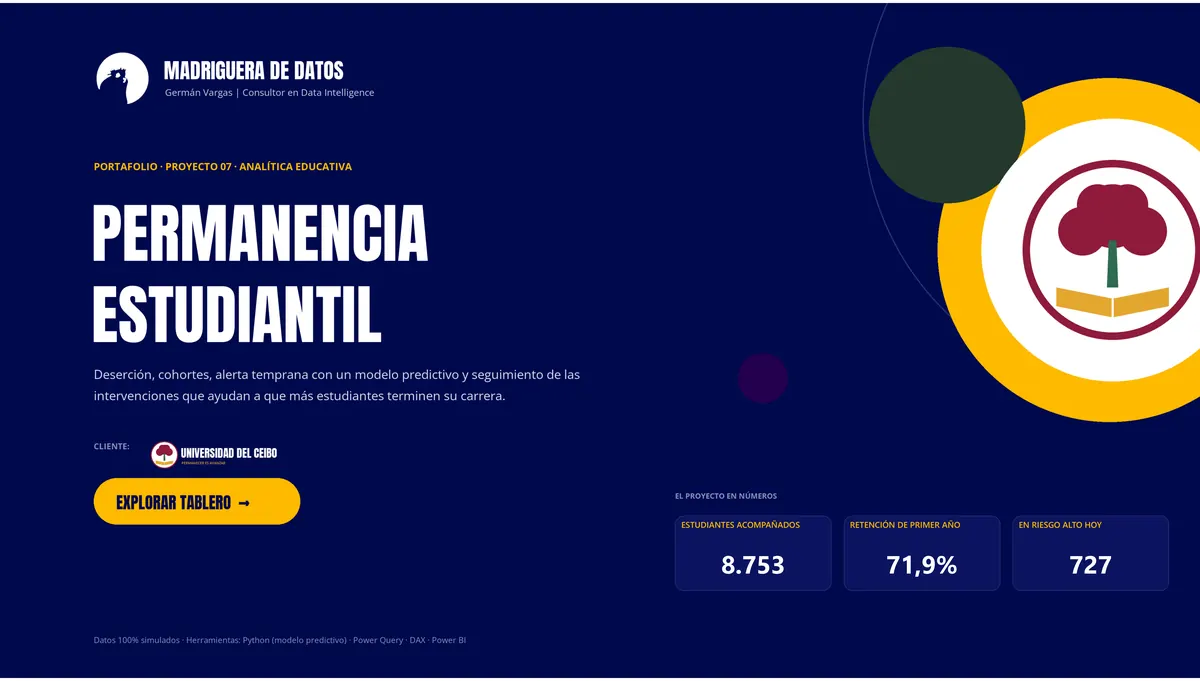 Power BI dashboard
Student retention
Dropout, cohorts, early warning with a predictive model, and tracking of the interventions that help more students finish their degree.
View prototype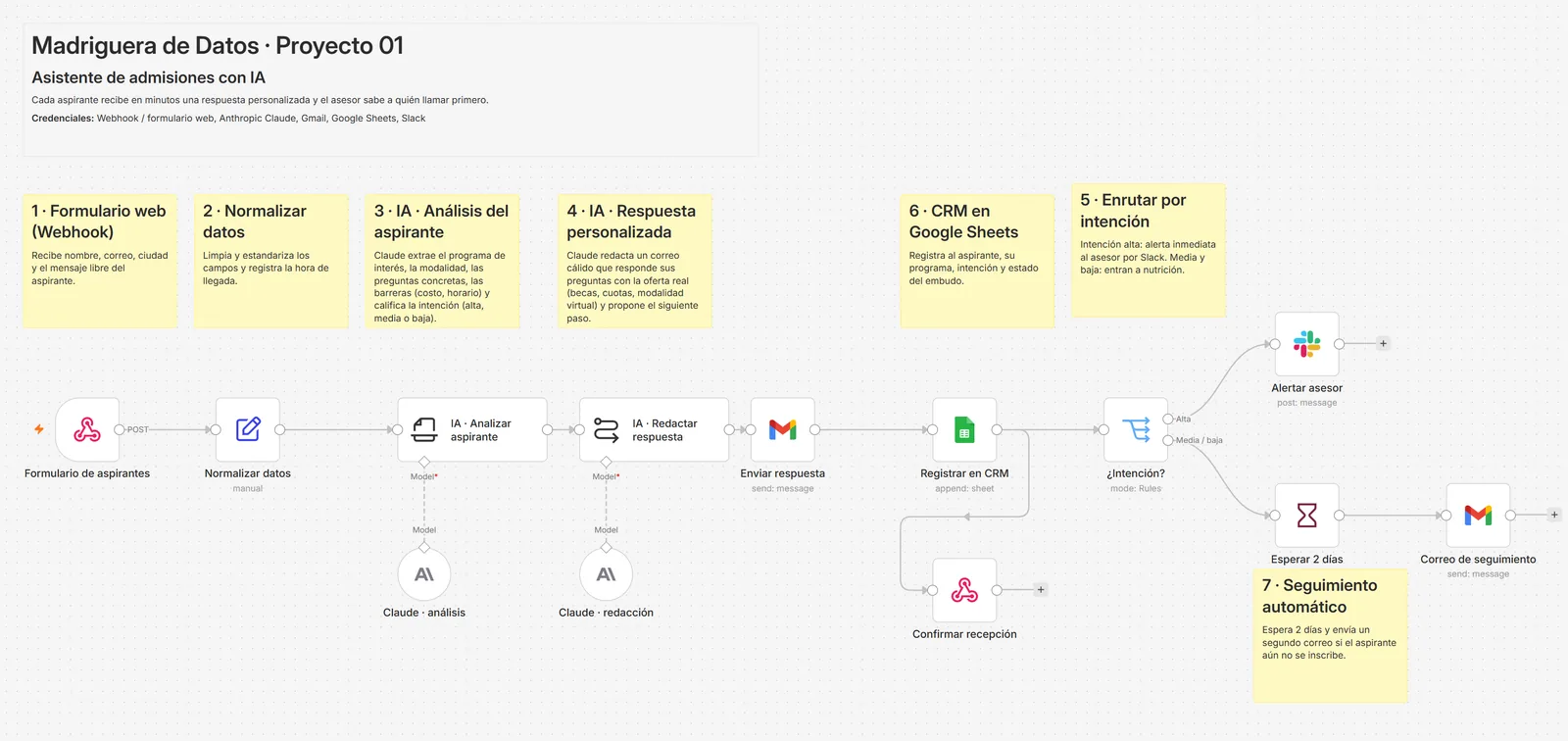 n8n + AI automation
AI admissions assistant
Every applicant gets a personalized reply within minutes, and advisors know who to call first.
View prototype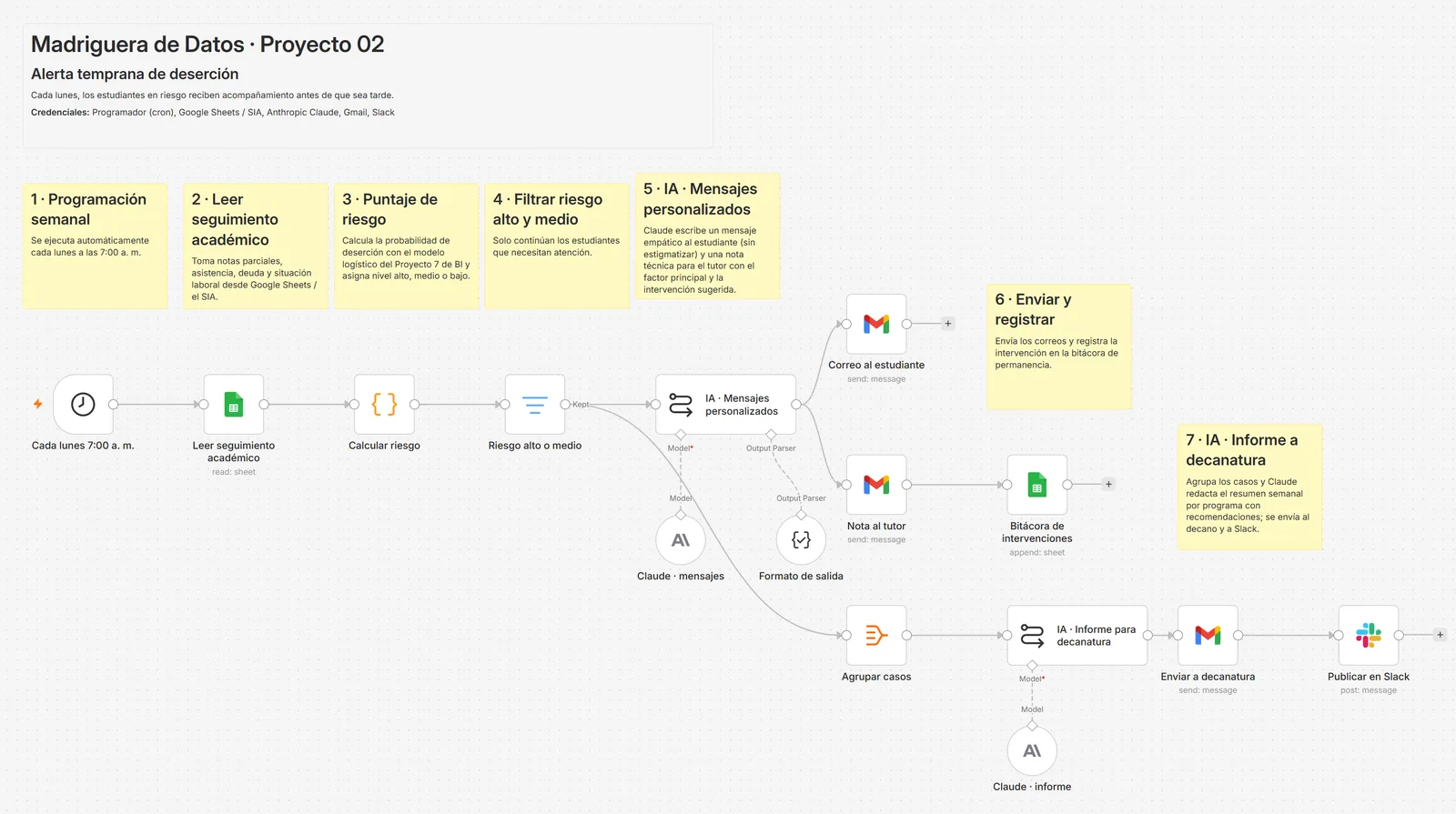 n8n + AI automation
Dropout early warning
Every Monday, at-risk students get support before it’s too late.
View prototype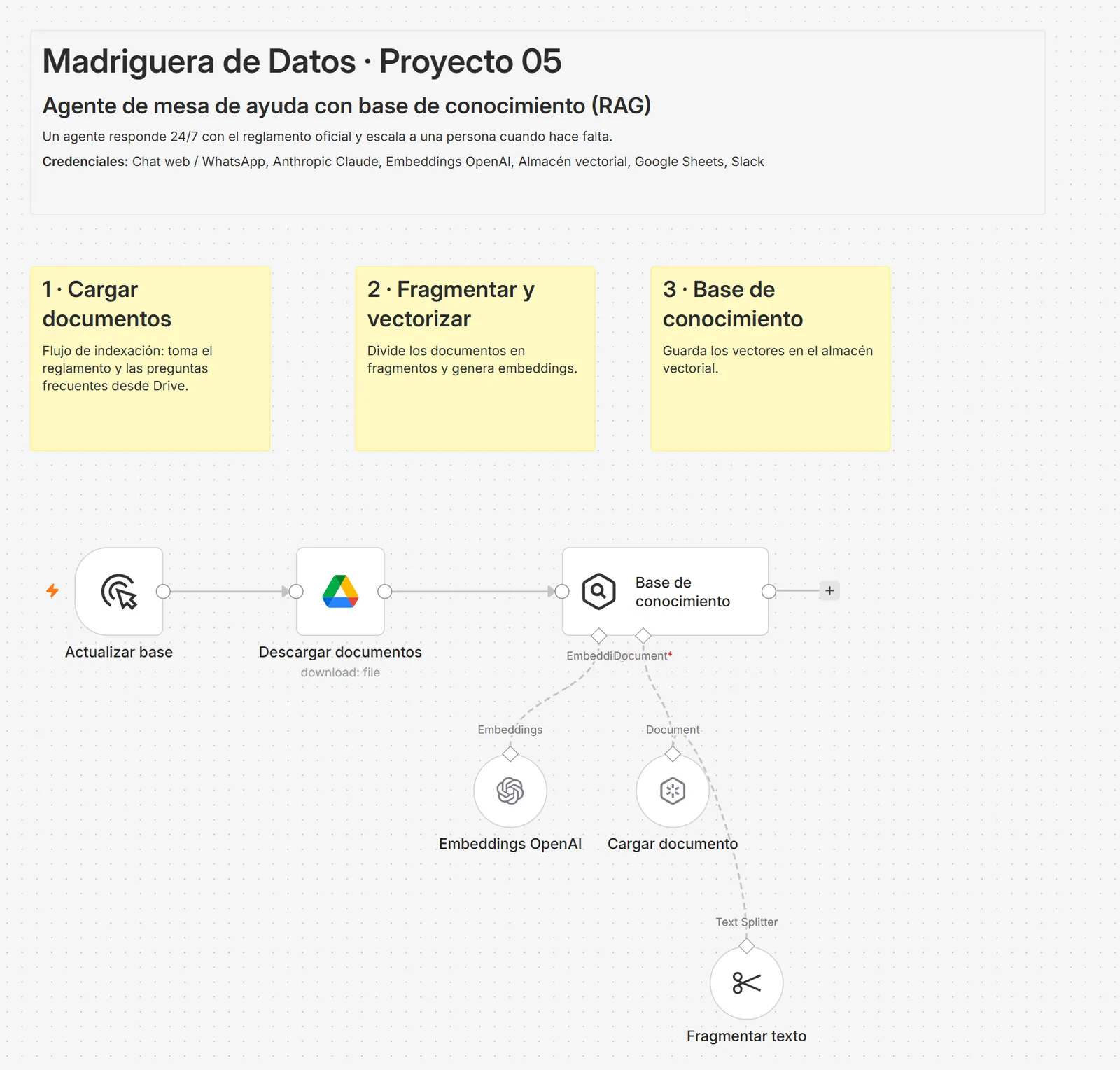 n8n + AI automation
Help desk agent with RAG
An agent answers 24/7 from the official rules and escalates to a person when needed.
View prototype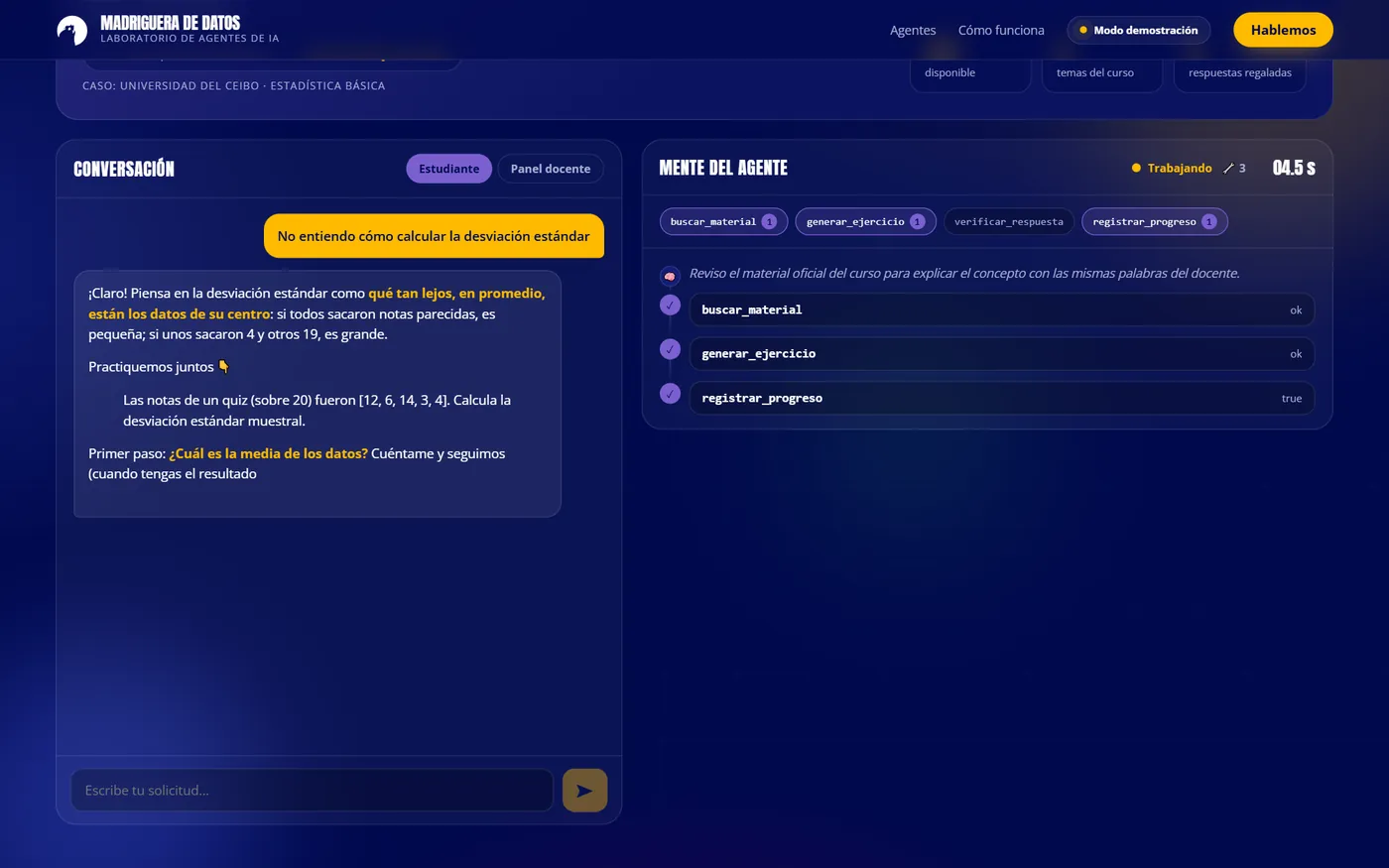 AI agent
AI academic tutor
A Socratic tutor that explains with the course material, generates exercises, gives hints without revealing answers, and feeds a teacher dashboard.
View prototypeDeep knowledge of the education sector
Madriguera combines experience in analytics, institutional evaluation, education indicators, retention, student profiles, and outcome measurement. That experience becomes solutions that academic and administrative teams can actually use.
Explore our higher education prototypes
These tools show how we organize information. They do not use real student data or make guaranteed predictive claims.
Student Retention & Success Observatory
Problem it represents: Late detection of dropout risk and disconnection between academic records, programs, and student services.
Decision it helps explore: Focus support resources on the programs and courses with the strongest signals of absenteeism or course repetition.
Quality & Planning Control Center
Problem it represents: Information scattered across many Excel files, evidence prepared manually at the last minute, and goals without continuous monitoring.
Decision it helps explore: Anticipate deviations from the strategic plan and keep evidence ready for accreditation committees.
Let’s start with a decision that is hard to make today
Tell us what information you have, which question you need to answer, and who should act on the result.